

STEM Story Boxes for the Classroom: An Easy Grab-and-Go STEM System
I love the idea of giving kids more opportunities to build, create, solve problems, and think critically.
What I don't love?
Searching through cabinets for tape while 24 children wait.
Or remembering halfway through the lesson that the craft sticks are in another cabinet.
Or knowing I printed that STEM challenge somewhere.
This is one reason hands-on learning can feel harder to fit into an already busy elementary classroom. It's not necessarily the activity itself.
It's the logistics.
That's why I love STEM story boxes for the classroom.
The idea is simple: take a great children's book, pair it with an open-ended STEM problem and a handful of basic building materials, and keep everything together.
Gather it once.
Then, when you have 30 minutes for STEM, you don't have to start collecting supplies.
Grab the box and go.
What Is a STEM Story Box?
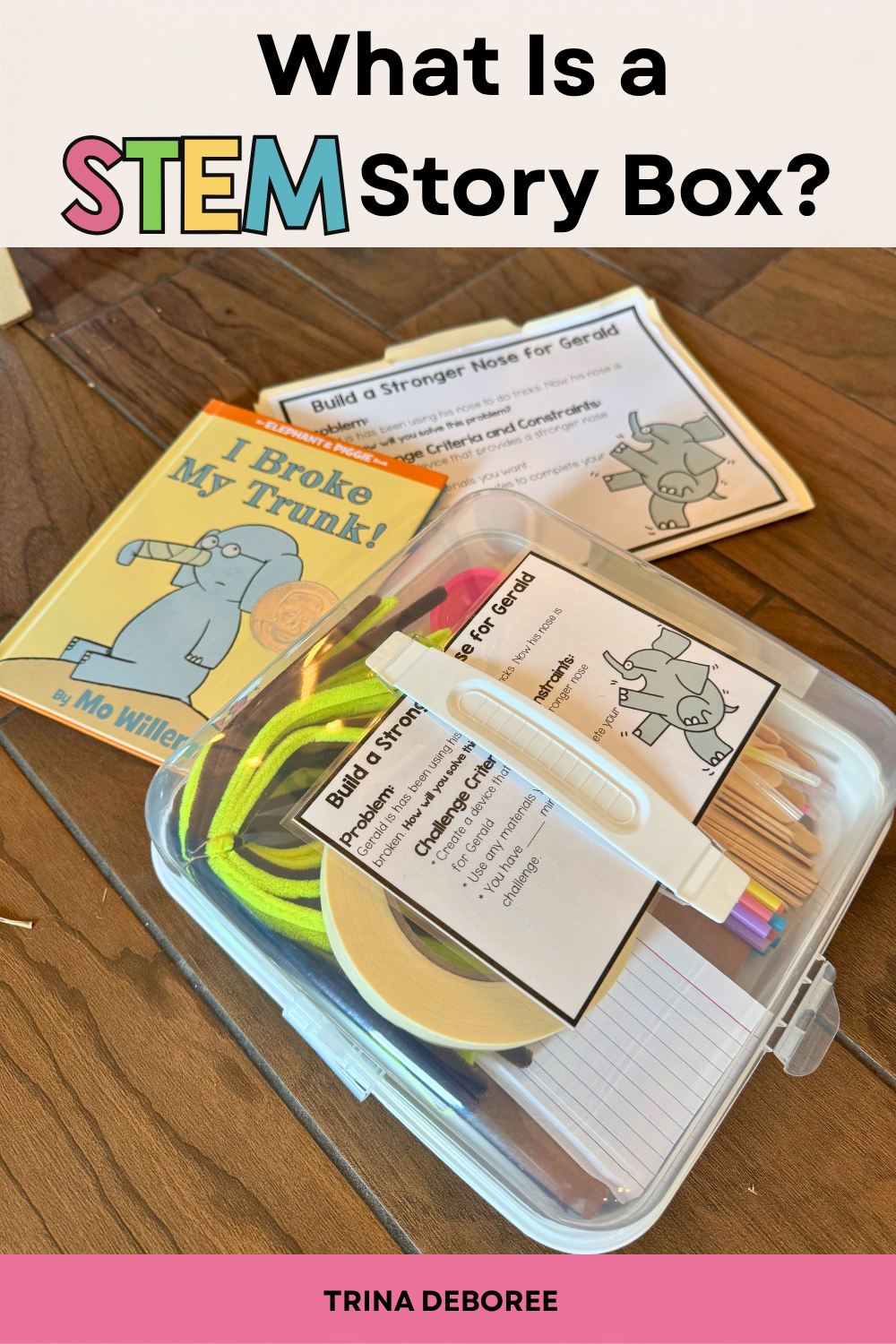
A STEM story box connects a children's book to a problem students can solve through building, creating, and engineering.
You really only need three things:
A story. A problem. Materials to solve it.
That's it.
You don't need an expensive STEM kit or a beautifully stocked makerspace.
In fact, I prefer simple building materials because they give children more freedom to decide what those materials could become.
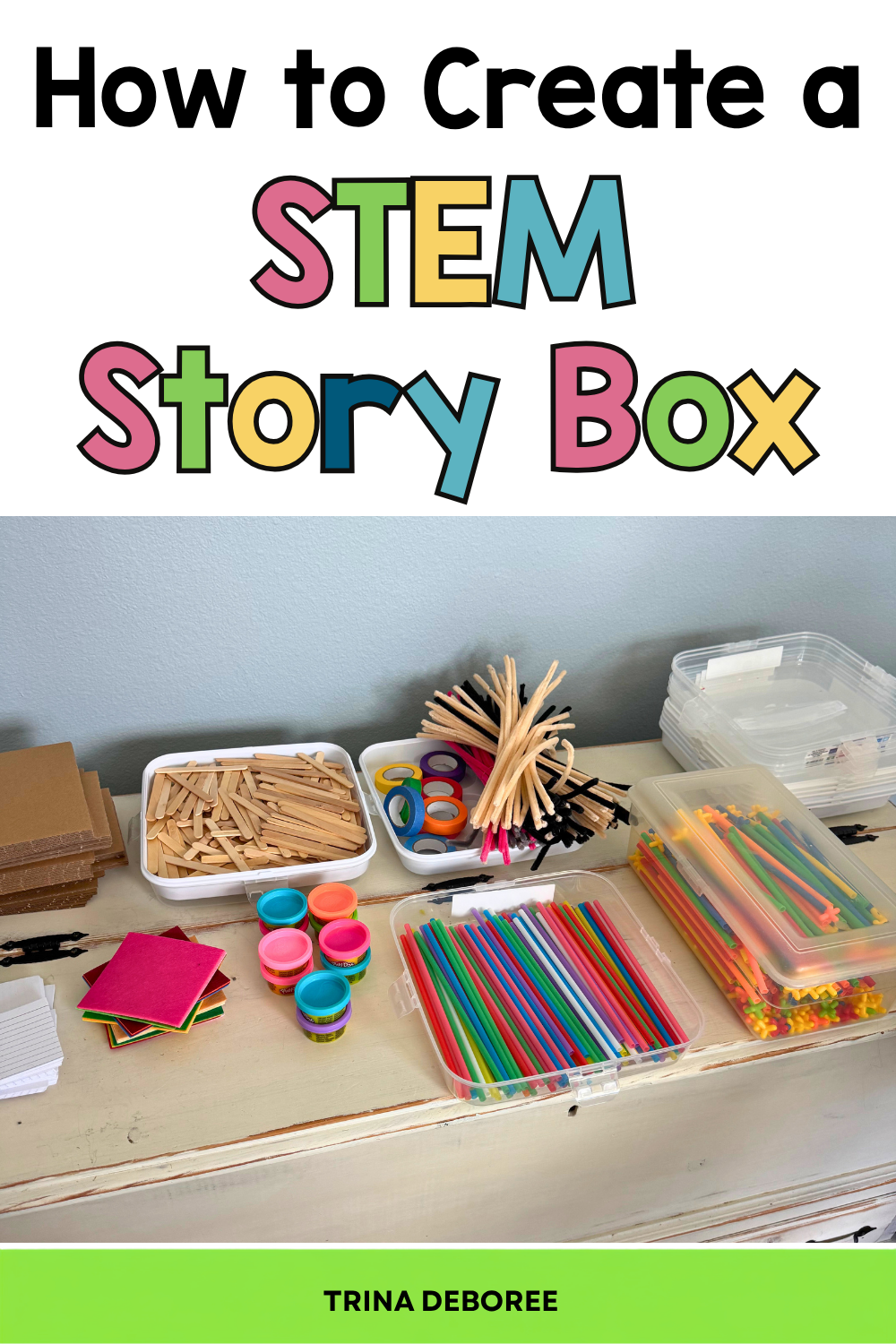
Think cardboard, craft sticks, pipe cleaners, straws, index cards, Play-Doh, felt, cups, recyclables, and—of course—tape.
Because tape alone can solve approximately half the problems in an elementary classroom. 😂
The materials aren't the most important part anyway.
The magic is what children decide to do with them.
Need a simple supply list to get you started? Click and grab my go to STEM resources from Amazon.
Why I Started Making STEM Story Boxes
Recently, my parents wanted to make a significant donation to an organization that helps families get back on their feet.
We couldn't simply send digital resources, so I decided to build something.
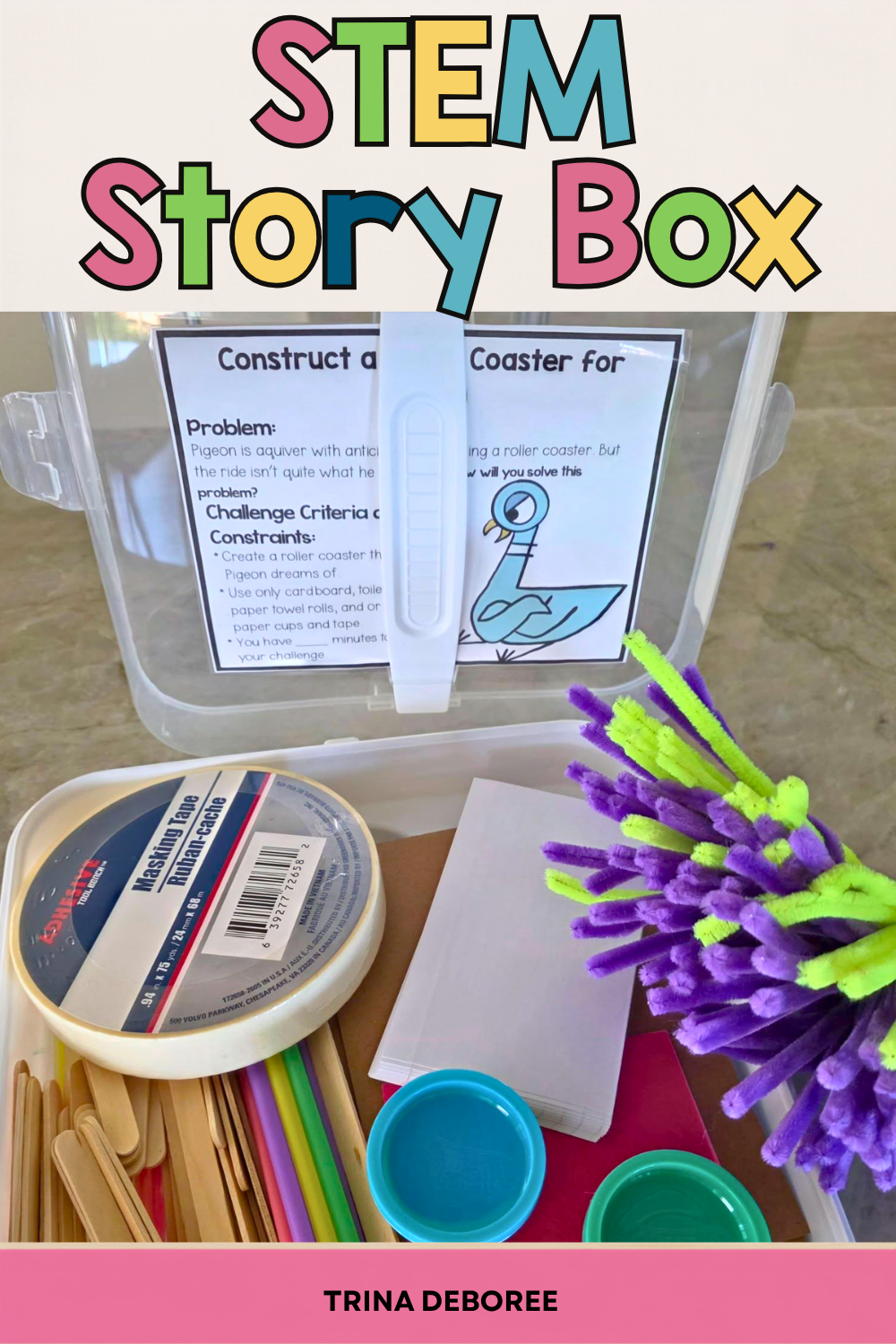
I put together 20 physical STEM story boxes—ten based on Elephant & Piggie books and ten based on Pigeon books.
Each box included a story, materials, and an invitation to build.
As I assembled them, I kept thinking about how useful the same idea could be in a classroom.
Teachers don't usually avoid hands-on learning because we don't believe in it.
Sometimes we avoid it because we're tired.
We don't have time to find the book, print the challenge, locate the cardboard, discover we're out of tape, and gather 17 different supplies before the kids can even begin.
A grab-and-go STEM box reduces that friction.
And when something is easier to use, we're more likely to actually use it.
How to Create STEM Story Boxes for Your Classroom
You don't need to make 20 boxes.
Please don't read this and turn it into your weekend project. 😂
Start with one.
Here's the process I use.
1. Start With a Story
Choose a picture book with a character, setting, situation, or problem that naturally makes children wonder what they could create.
You don't need to force an engineering challenge onto every book you read.
Instead, look for the invitation that's already inside the story.
Characters like Pigeon, Elephant & Piggie, and the characters in the Food Group books work beautifully because their stories are filled with problems, wants, mishaps, and wonderfully ridiculous situations.
The story gives children a reason to care about the problem before they ever pick up a craft stick.
2. Find a Problem Worth Solving
After choosing the book, ask:
What could my students solve, build, or create because of this story?
Better yet, see whether your students can identify the problem themselves.
The less you prescribe the final product, the more thinking children have to do.
For example, I love The Unbudgeable Curmudgeon by Matthew Burgess.
There's an unbudgeable Curmudgeon who simply will not budge.
There's our problem.
But instead of announcing, "Today we're building a machine that moves the Curmudgeon," we can ask:
How could we solve this problem?
Now children have to think.
How do you get someone to move when they refuse?
Could you invent something that physically moves him?
Could you create something that makes him laugh?
Could you design something that cheers him up so he wants to move?
Maybe a child comes up with something neither of us would have imagined.
Good.
That's exactly what we want.
There isn't one correct solution waiting for them.
The thinking is the work.
3. Add Simple STEM Materials
Once students have a problem to solve, give them a few versatile materials.
You don't need 17 choices.
Actually, fewer materials can require more creativity because children have to think differently about what each item could become.
A straw isn't just a straw anymore.
Could it be an axle? A support? A tunnel? A handle?
A piece of cardboard isn't trash.
It's whatever the child needs it to become.
That's part of the experience.
4. Give Kids the Problem, Not the Solution
This may be the most important part of creating STEM story boxes.
Keep the challenge open-ended.
If we show children exactly what they're supposed to build and then walk them through exactly how to build it, we've removed much of the STEM thinking.
They may be making something with STEM materials.
But we're doing a lot of the problem-solving for them.
Instead:
Give them the problem, not the solution.
If there are 24 children in the classroom, I want the possibility of seeing 24 different solutions.
One might work beautifully.
Another may fall apart immediately.
Someone may realize halfway through that the original plan isn't going to work.
Perfect.
Now we have a reason to redesign.
That's where critical thinking, creativity, communication, collaboration, and problem-solving become more than words on a poster.
Children are actually practicing them.
5. Put Your STEM Story Box Together Once
This is the teacher-saving part.
Keep the book, challenge, and materials together when you can. If you share books or supplies, keep your reusable STEM materials organized so the box is easy to replenish.
You're creating a system for future-you.
So when you look at the schedule and realize:
Wait. We have 30 minutes.
You don't have to plan something.
Grab the box.
That's the whole point.
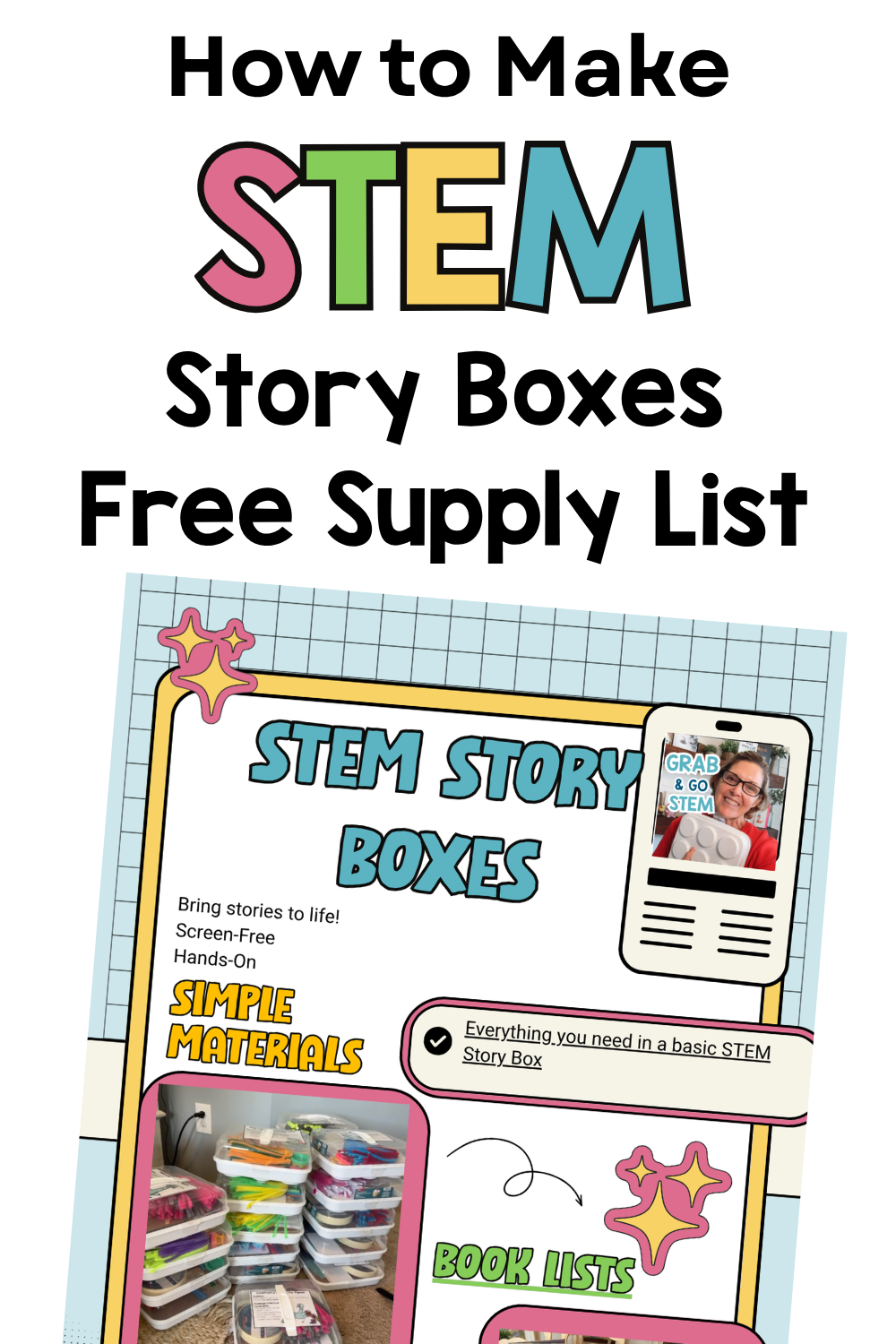
Need help finding the supplies? I’ve got a free supply list for you here.
STEM Story Boxes Are About More Than Organization
There's another reason I think these experiences matter.
Children live in a world filled with things that have already been made for them.
They can tap something and watch it.
Click something and receive it.
Ask something and get an answer.
There is incredible value in technology, but children also need experiences where nothing exists until they make it.
Here's a pile of materials.
Here's a problem.
What do you think we should do?
Now they have to imagine something that doesn't exist yet.
Make a decision.
Try.
Fail.
Change the plan.
Ask someone for an idea.
Try again.
Children need opportunities to make things—not just complete things.
That's one of the reasons I'm talking so much this month about protecting childhood.
I want children to have time to wonder, play, investigate, build, and create something that didn't exist before they walked into the room.
Those experiences can disappear pretty quickly when we're all under pressure to cover more, measure more, and move faster.
They're worth protecting.
Start With One Grab-and-Go STEM Box

If you've been wanting to add more hands-on STEM activities to your elementary classroom, you don't need to start by building a giant makerspace.
Start with:
One box. One book. One problem. A handful of simple materials.
Then let your students build.
See what happens.
You can always make another STEM story box later.
And please don't feel like you need 20 beautifully labeled boxes lined up on your shelf by Monday morning.
You probably already have a children's book.
You probably have cardboard, paper, tape, straws, or craft sticks somewhere in your classroom.
That's enough.
Simple counts—especially when simple means you're actually able to use it with your kids.
Want the STEM Story Box Setup Done for You?
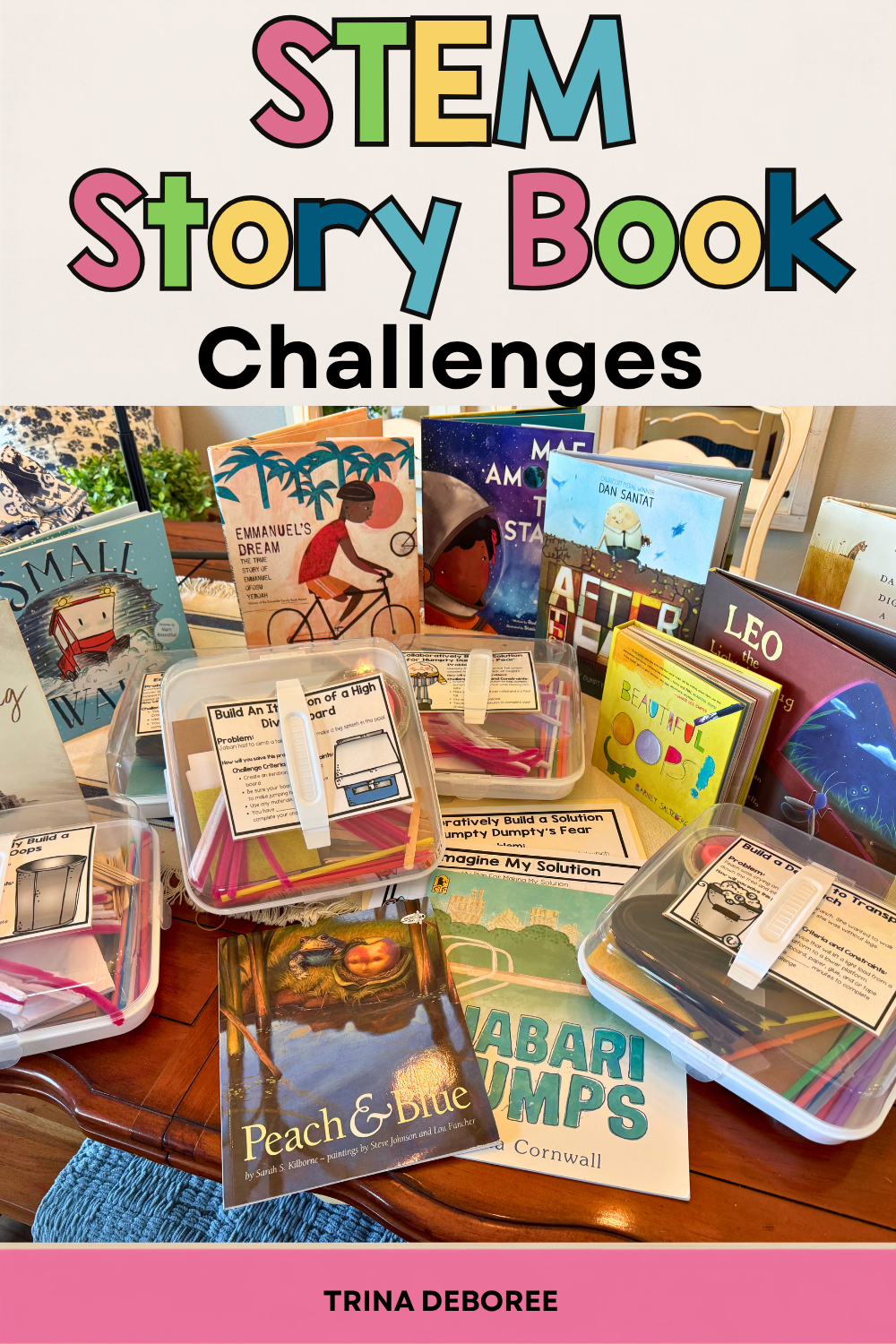
If you like the idea of STEM story boxes for the classroom but don't want to create all of the STEM challenges yourself, my Storybook STEM Challenges were designed for exactly this kind of learning.
I've created challenges around some of my favorite children's books, including Mo Willems favorites featuring Elephant & Piggie and Pigeon.
I also put together a free Simple STEM Story Boxes download with the materials and setup I use to make these grab-and-go STEM experiences easier.
[FREE SIMPLE STEM STORY BOXES]
You absolutely don't need my exact supplies, boxes, or challenges to make this work.
Use what fits.
Leave the rest.
Because the goal isn't a perfect STEM box.
It's making it a little easier to give children the opportunity to look at a problem, look at a pile of materials, and think: