

5 STEM Sub Plans: Easy Grab-and-Go STEM Activities for K–6
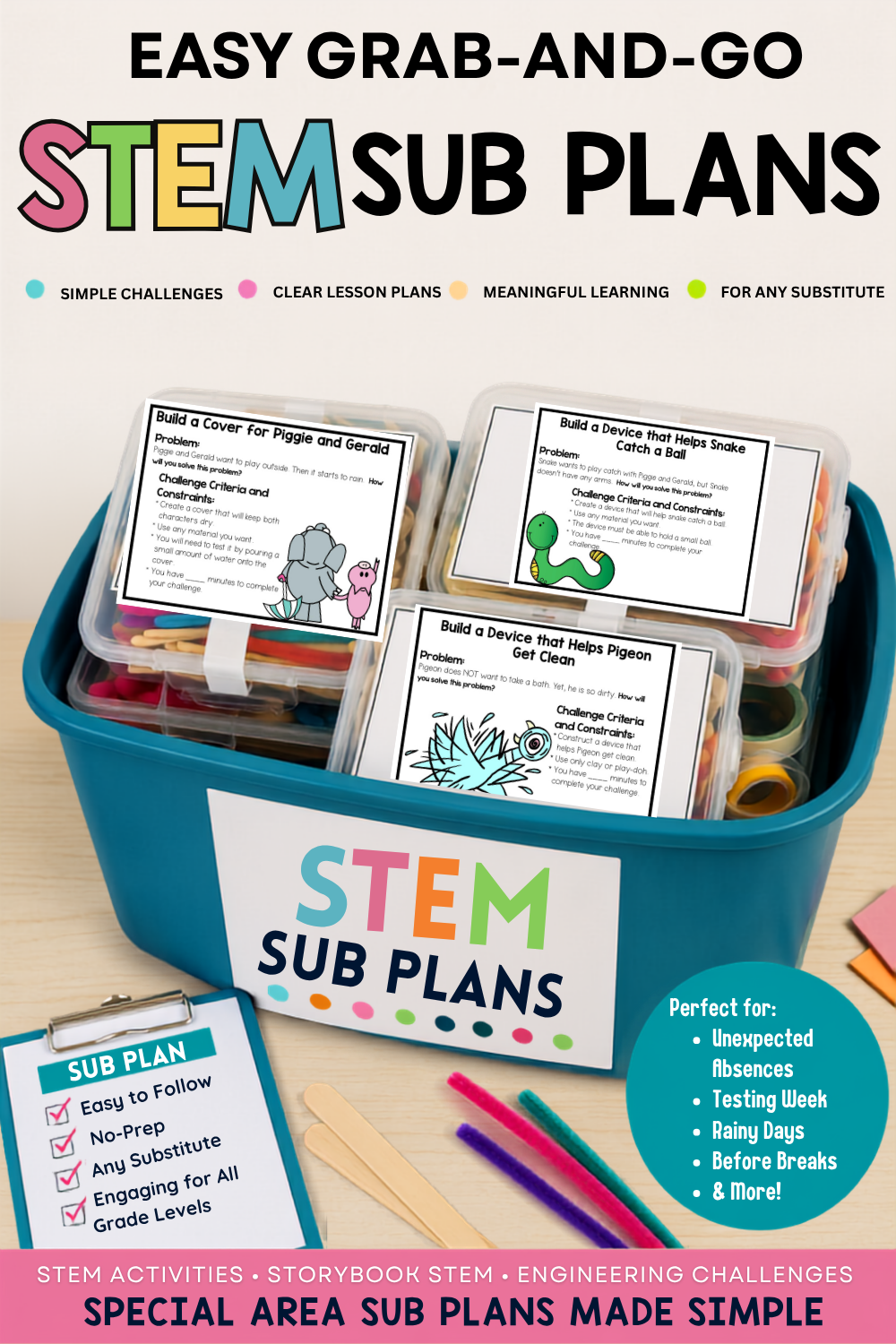
How Can I Create a Sub Binder For Grades K-5 STEM With Easy Lesson Plans for Subs?
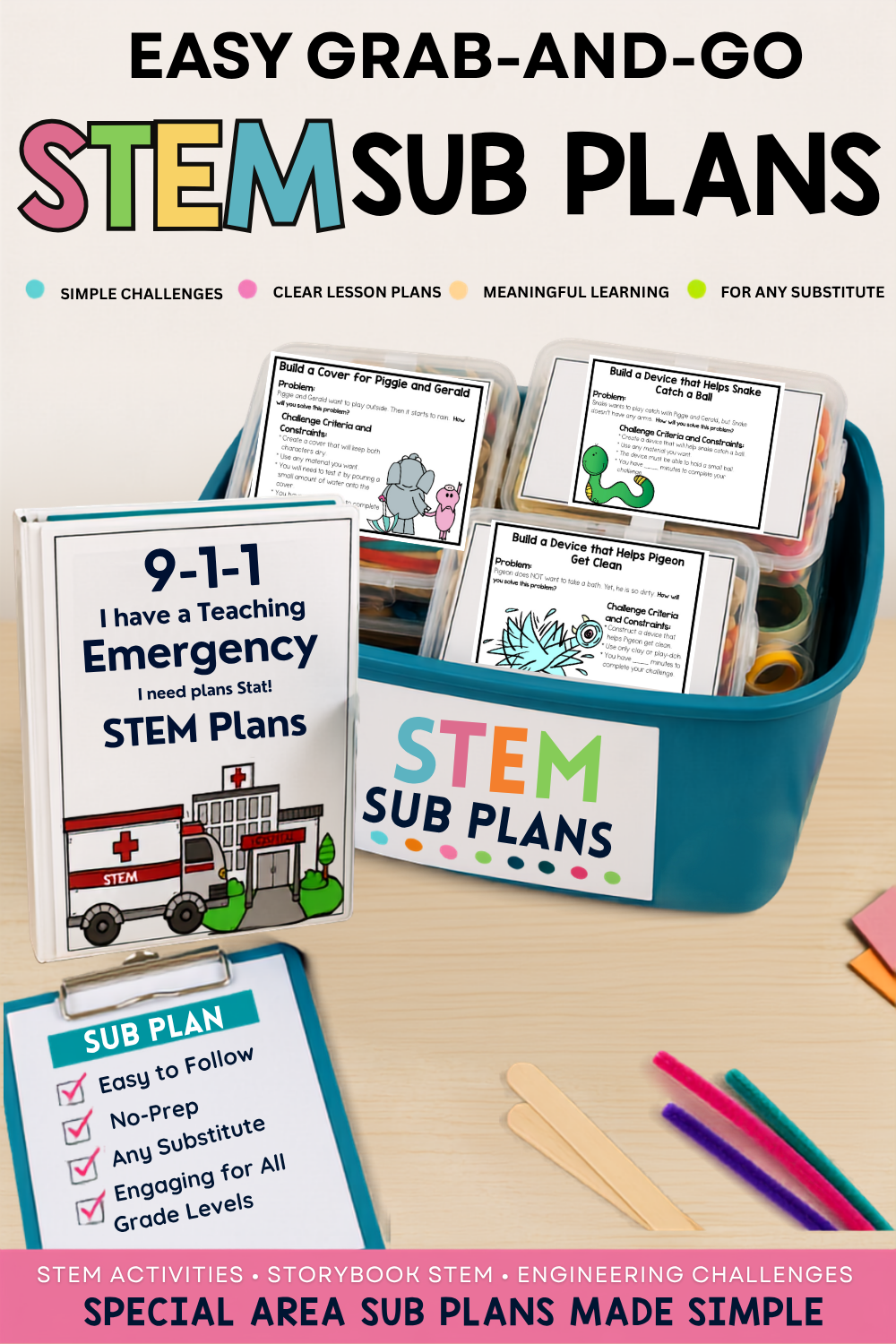
I can’t tell you how many times I see this question in STEM groups I am in on Facebook. And today I’m going to answer this question. I hope you stick around…
If you teach STEM as a special area, preparing for a substitute can feel like an entirely different challenge.
You aren't planning for one class.
You might see kindergarten, first grade, third grade, fifth grade—and then start all over again with another group.
And if you're creating STEM sub plans for several grade levels, the last thing you want to do at 6:00 in the morning is write five different STEM lesson plans, gather five sets of materials, and try to explain your entire makerspace to someone who may have never taught STEM before.
The good news?
You don't need five completely different lessons.
In fact, when it comes to special area sub plans, I think simpler is almost always better.
A few flexible STEM challenges, familiar materials, clear directions, and a predictable routine can give your substitute what they need while still giving students a meaningful day of problem-solving, building, and creating.
So if you've been wondering how to create a STEM sub binder—or what you could possibly put in a grab-and-go STEM tub—here's where I would start.
What is the Goal of STEM Sub Plans?
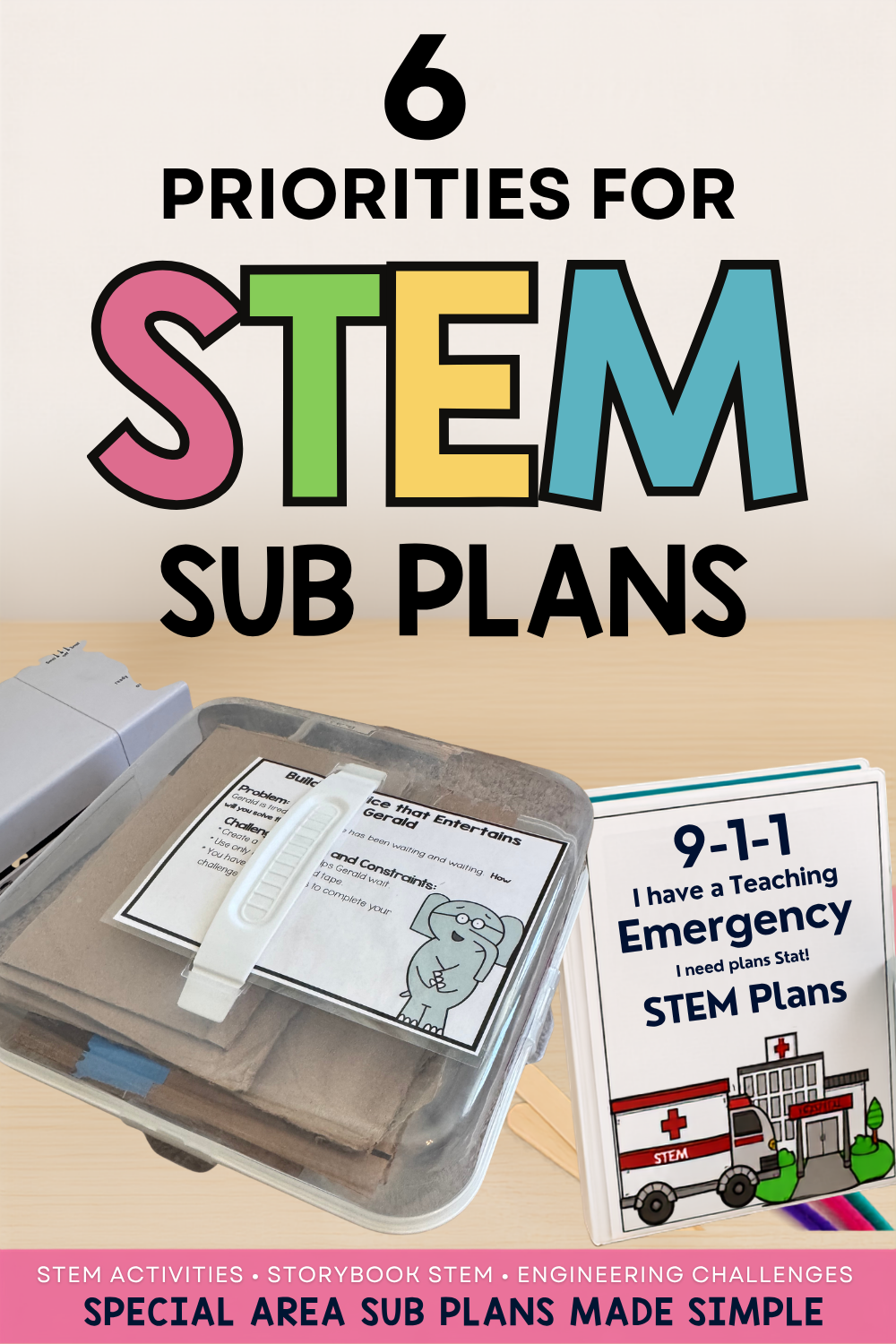
This is probably the most important thing I learned from years of creating emergency sub plans:
Your substitute does not need to teach exactly like you.
They don't need to continue the complicated engineering project your fifth graders started yesterday.
They don't need to understand every part of your STEM curriculum.
And they definitely don't need a three-page explanation of everything you normally do during a 45-minute class.
Your goal is to leave enough information that another adult can walk into the room, understand what students are supposed to do, and keep the day moving.
That's it.
(Even if you have a misguided administrator who tells you that your lesson plans should be so detailed that anyone can teach off of them. We all know that is ridiculous. And I don’t know about you, but when I have left emergency sub plans, I want to come back to a nice note, not a rant and a mess. So for now, set that advice aside and focus on STEM lesson plans any substitute can follow.)
For STEM, I would prioritize:
A simple challenge students can understand
Familiar, easy-to-find materials
A consistent routine
Clear expectations for materials and cleanup
A backup activity
Enough structure to support the substitute without scripting every minute
Think support, not information overload.
Your plans should answer the questions the substitute actually needs answered.
What am I teaching?
What do the kids need?
What should they do?
What do I do if they finish early?
Where does everything go when we're done?
If those questions are answered, you've already solved a huge part of the problem.
How do I Create a Grab-and-Go STEM Sub Tub?
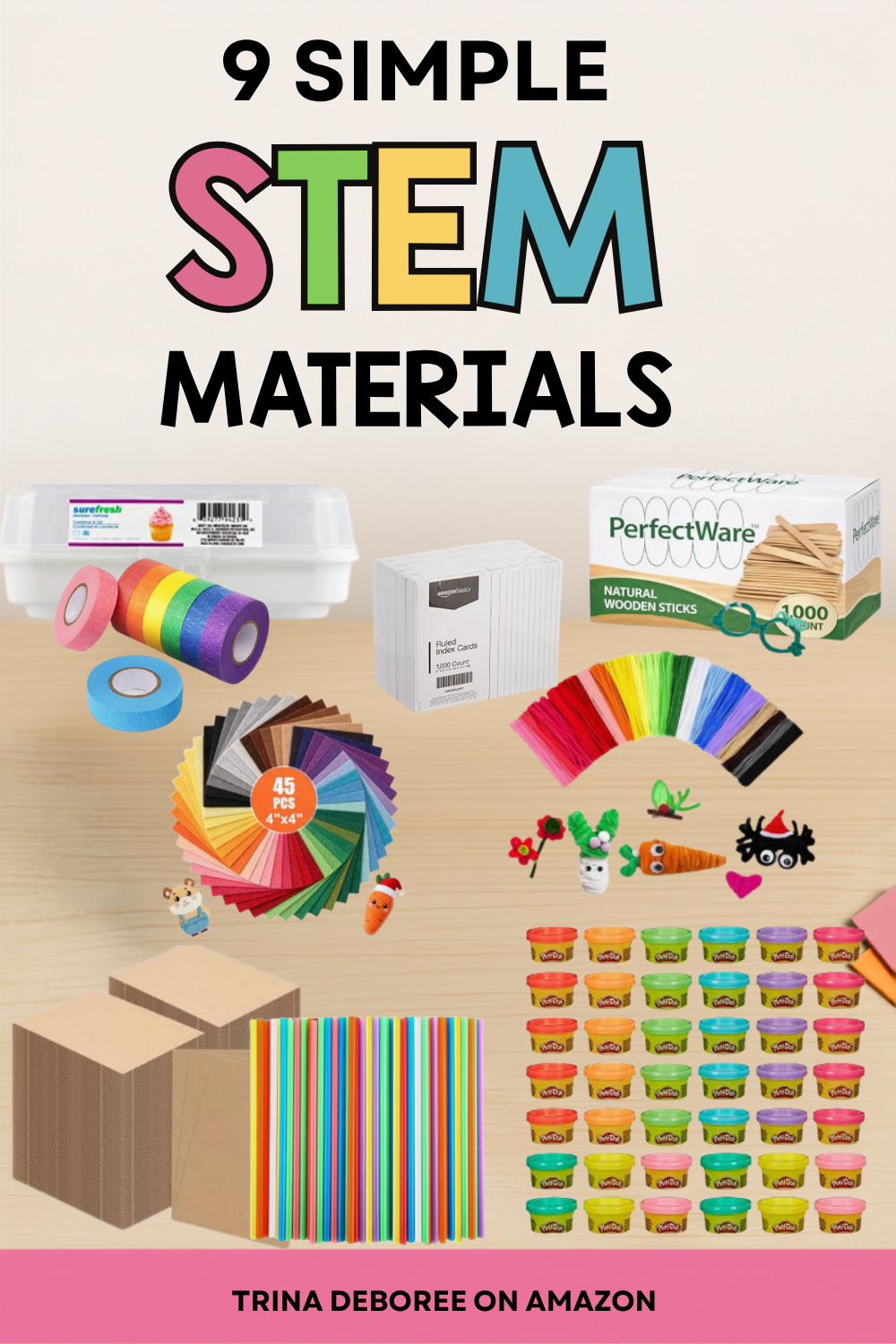
One of the easiest ways to prepare for an unexpected absence is to create a dedicated STEM sub tub.
This doesn't have to be elaborate.
In fact, I wouldn't make it elaborate.
The more complicated the system becomes, the harder it is to maintain throughout the year.
Instead, fill your STEM sub tub with materials that can work for lots of different STEM activities for kids.
You might include things like: (Simple STEM Materials in my Amazon Shop)
Index cards
Craft sticks
Paper cups
Straws
Pipe cleaners
Felt
Cardboard
Tape
Pipe Cleaners
Straws
Recycled materials
Then add printed STEM challenge cards, student planning sheets, reflection pages, and your basic STEM sub plans.
Now you're not preparing an entirely new activity every time you're absent.
You're creating a system once that you can return to throughout the year.
Do I Need a Different STEM Challenge for Every Grade?
If you teach K–5 or K–6 STEM, this is where I would save yourself some work.
Band your grade levels together.
For example:
K–1: Very simple build-and-test challenges with fewer materials and more visual directions.
Grades 2–3: The same basic problem with a little more independence, planning, and testing.
Grades 4–6: The same problem with additional criteria, constraints, data collection, or improvement requirements.
You don't necessarily need three completely different STEM activities.
You can change the expectation instead of changing the entire lesson.
Imagine the basic challenge is:
Build a floating device that helps friends get from one side of the lake to the other.
Your youngest students might simply build, test, and talk about the problem.
Second and third graders might draw a plan before building and make one improvement after testing.
Older students could work with specific material constraints, add weighted objects to the floating device to ensure it doesn’t sink when more weight is added, record results, analyze why their design worked or failed, and redesign.
Same basic STEM challenge. Different level of thinking.
That makes planning much more manageable for a K–6 STEM teacher.
How Do I Choose STEM Challenges That Don't Require Me?
This is especially important when choosingSTEM activities for sub plans.
There are wonderful STEM lessons that work beautifully when you are teaching them.
That doesn't automatically make them good sub plans.
For a grab-and-go activity, ask yourself:
Could someone who has never taught this lesson before understand it quickly?
If the answer is no, I probably wouldn't put it in the emergency STEM tub.
I would look for challenges with:
A problem students immediately understand
Few materials
Multiple possible solutions
Minimal teacher demonstration
No complicated science equipment
Easy cleanup
Natural opportunities for students to improve their designs
Things like building a shelter, creating a bridge, designing something that floats, protecting an object, constructing the tallest possible structure, or designing something that moves can work well because students can understand the goal without a lengthy lesson first.
That's what makes these kinds of challenges useful for both STEM lesson plans for teachers and emergency sub plans.
Keep the Engineering Design Process Consistent
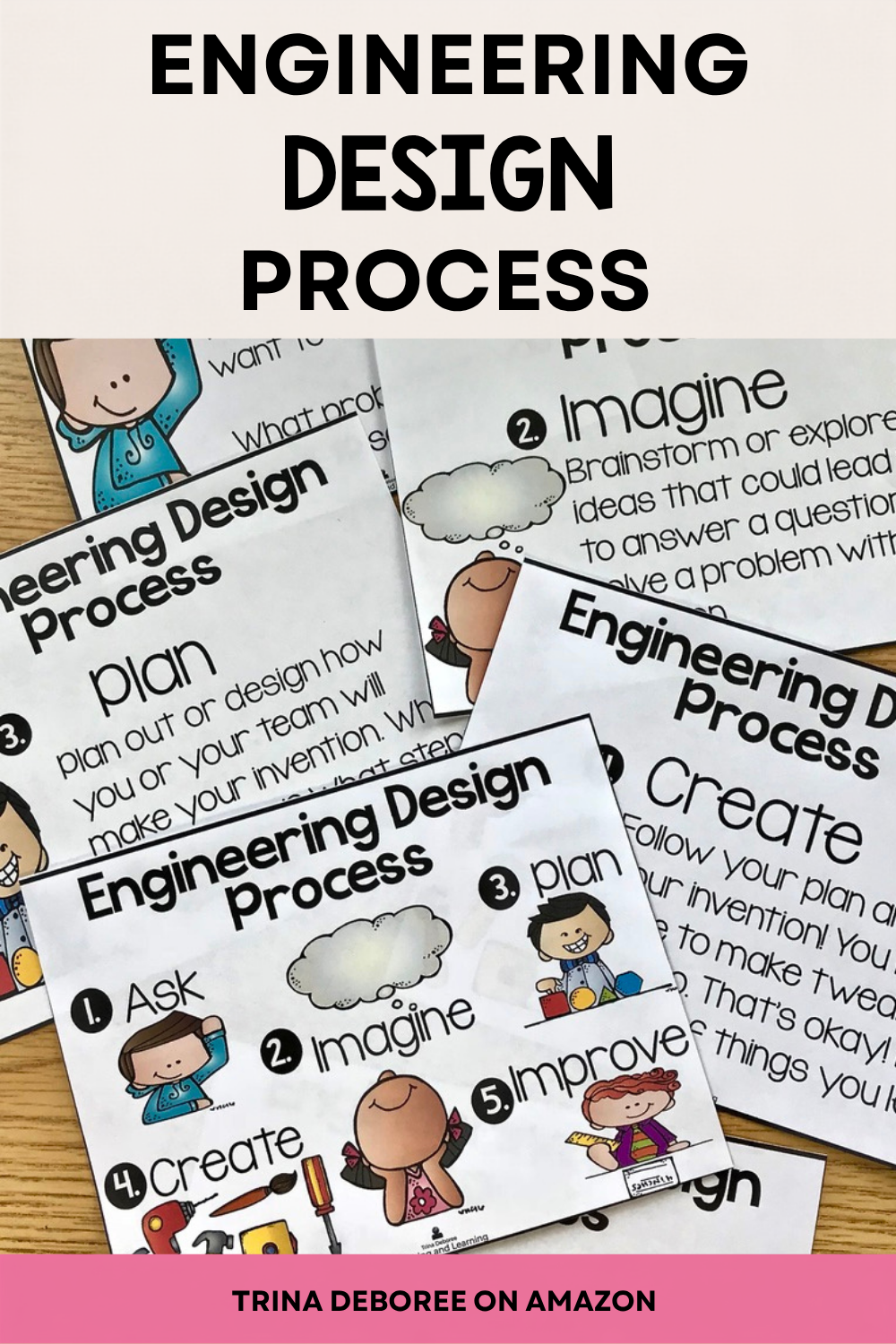
Another way to make STEM sub plans easier is to use the same basic process students already know.
In my STEM activities, I use the engineering design process:
Ask → Imagine → Plan → Create → Test → Improve
If students recognize that routine, your substitute isn't introducing an entirely new way of working.
The challenge changes.
The process doesn't.
That consistency matters—especially when the regular teacher isn't there.
Students know that they're going to think about the problem, plan a solution, build it, test it, and decide what they would change.
And here's something else I think is important:
The finished project doesn't have to be perfect.
The learning is in the thinking.
A design that falls over can lead to a fantastic conversation about why it fell over.
A bridge that can't hold the weight gives students information they can use during the improvement stage.
STEM doesn't have to produce a Pinterest-worthy final product to be meaningful.
What is a Simple STEM Sub Lesson Structure
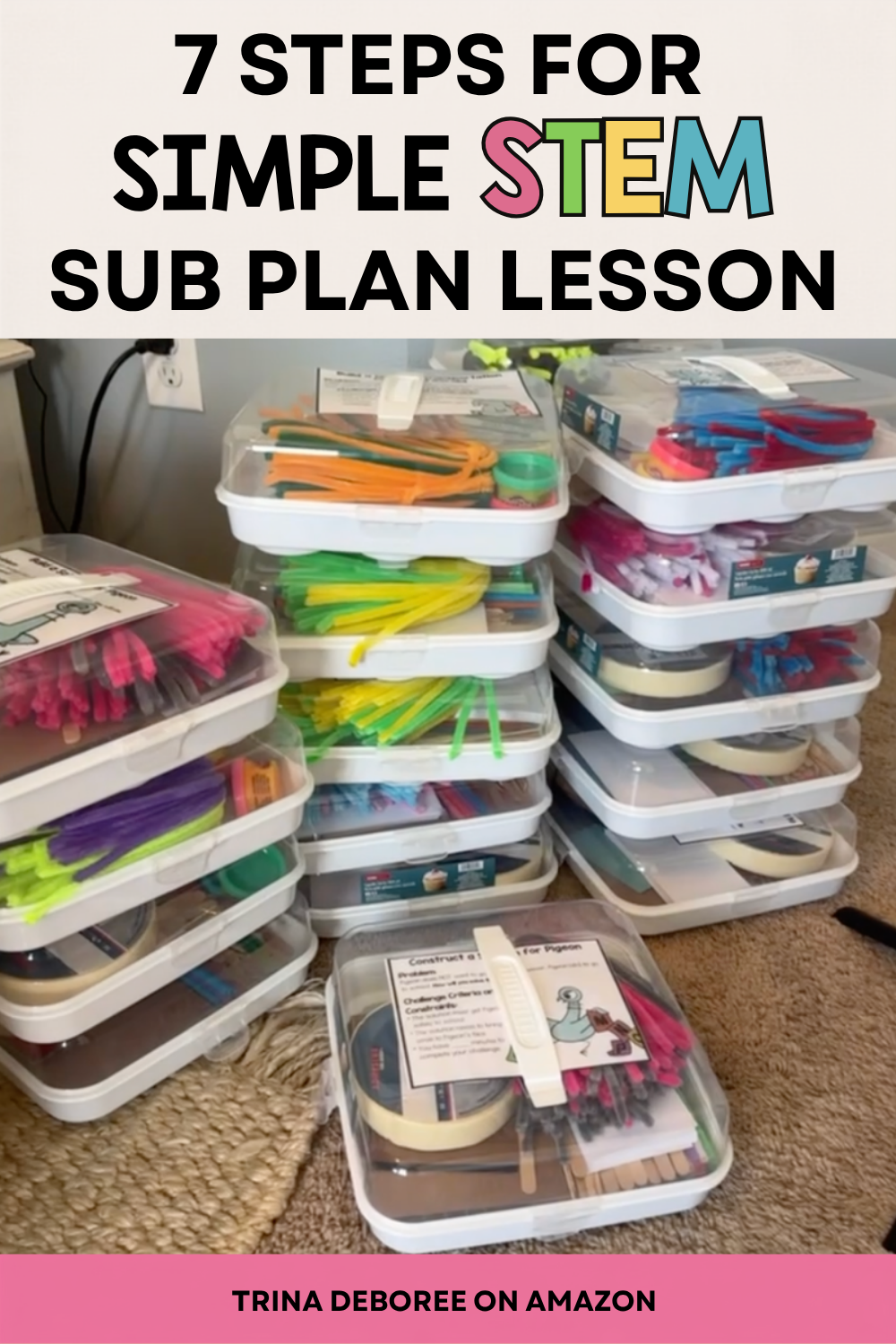
If I were creating STEM sub plans for K–5, I would use almost the same structure every time.
1. Introduce the Problem
Give students a simple scenario or problem to solve.
Keep this short.
2. Ask and Imagine
What is the problem?
What could we build?
What ideas do we have?
Younger students can discuss their ideas. Older students can record them.
3. Plan
Students sketch or describe what they want to create.
Again, this doesn't need to be complicated.
4. Create
Students use the available materials to build their solution.
5. Test
Does it work?
What happened?
6. Improve
What would make the design better?
If time allows, students can actually redesign. If it doesn't, they can simply explain what they would change in a quick turn-and-talk.
7. Clean Up and Reflect
Build cleanup into the lesson rather than treating it as an afterthought.
This is especially helpful for a substitute!
Students can finish by drawing, writing, or discussing:
What worked?
What didn't work?
What would you change next time?
That's a complete STEM lesson without requiring the substitute to be a STEM expert.
What Should Go in a STEM Sub Binder?
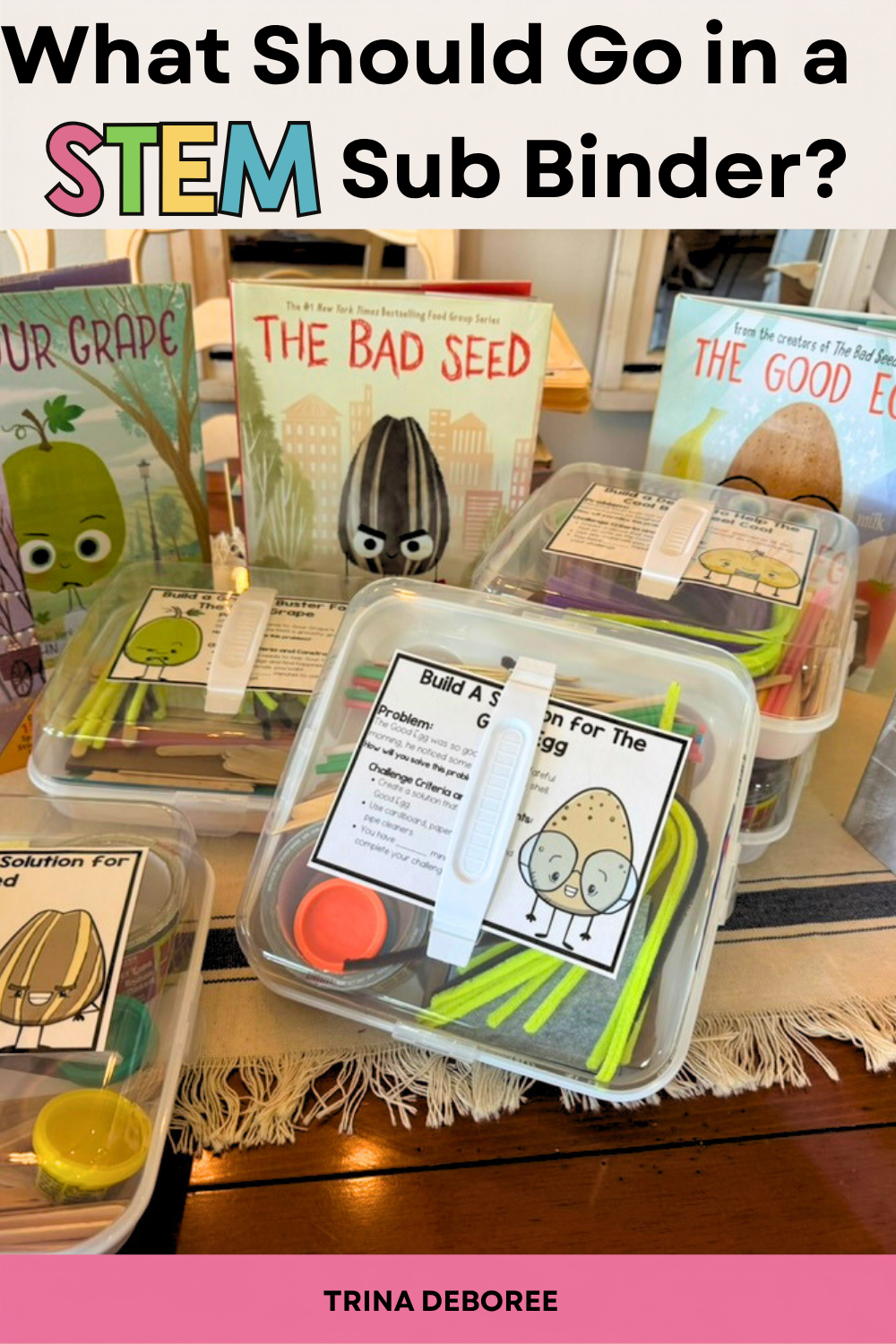
Your physical materials can live in your STEM tub, but I would keep the important classroom information in a clearly labeled STEM sub binder.
Again, don't overwhelm the person.
Include the information they actually need:
Daily class schedule or at least the rotation schedule and a teammate who can tell the sub what day you are on (that should only take 1 minute of their time)
Class lists if appropriate
Arrival and dismissal procedures
Emergency procedures (Simply staple your school safety plan. You don’t need to rewrite it.)
Classroom management information
Where STEM materials are located
Materials students may and may not use
Cleanup procedures
Technology information they will need
Names of nearby teachers who can help
A simple plan for each grade band
Early-finisher options
A quick note explaining your normal STEM routine
And here's one tiny thing that can make a surprisingly big difference:
Tell someone where the binder and STEM tub are.
A beautiful emergency sub binder locked inside your classroom isn't very helpful when you're home sick, and nobody knows it exists.
Choose a teammate, secretary, neighboring teacher, or administrator who knows exactly where your emergency plans are stored. (This is key!)
(I have included some sub templates to get you started inside of my No Prep STEM Challenge Bundle. You can find them below.)
No-Prep STEM Challenges | Day Before Spring Break, Testing, Rainy Day Activities
Do You Have Go-To STEM Building Challenges for Sub Plans?
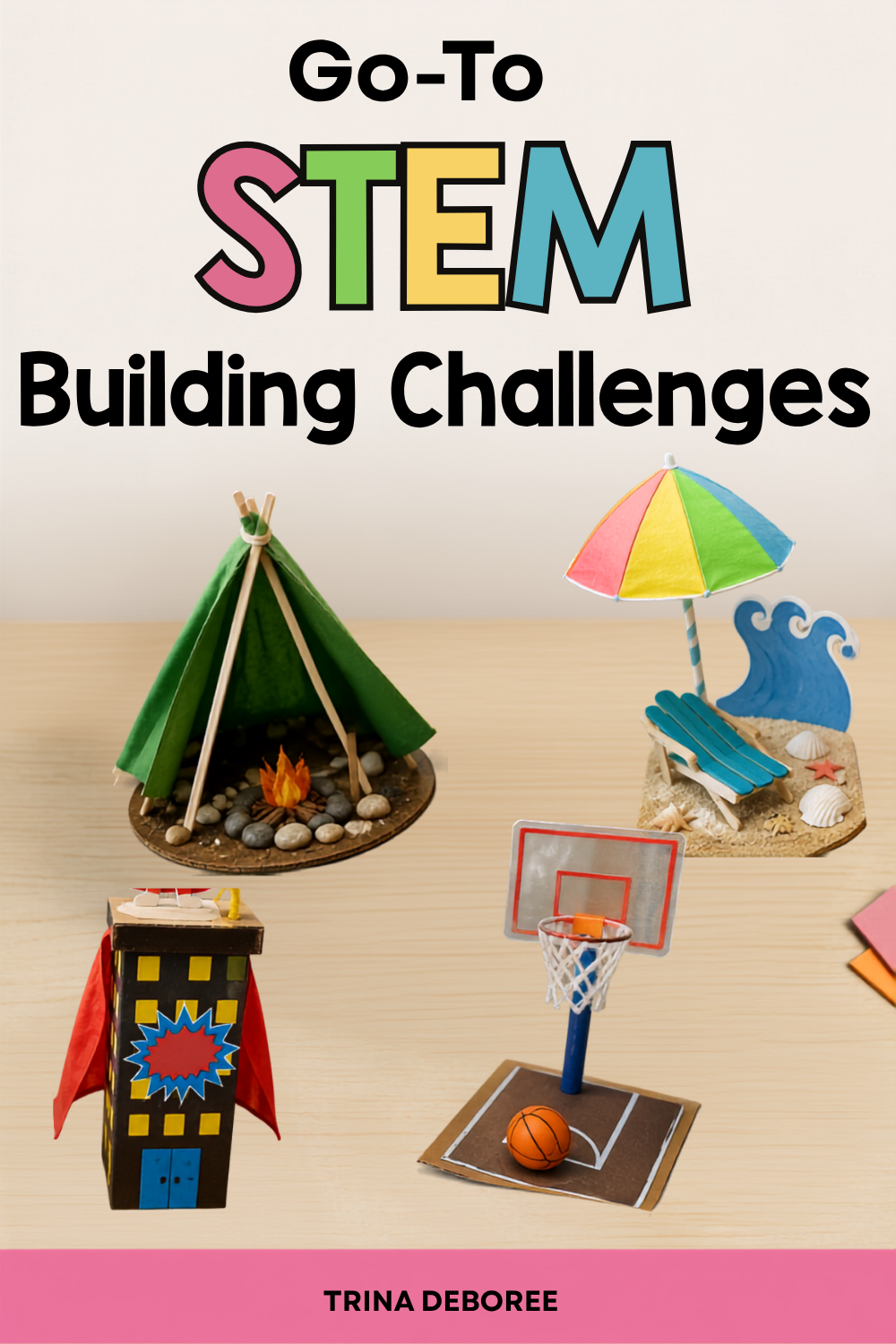
If I were creating one collection of grab-and-go STEM challenges to use throughout the year, I would choose activities that aren't tied too tightly to one science standard or one specific week.
That's actually one reason I created my No-Prep STEM Challenges bundle.
It includes more than 40 STEM challenges across themes including beach, camp, superheroes, and sports.
I recently added STEM sub plan templates specifically because these activities work so well for those days when you need something meaningful without requiring the substitute to continue your regular instruction.
Students work through real-world problems using the engineering design process as they:
Ask → Imagine → Plan → Create → Test → Improve
The challenges include student think sheets, essential questions, collaboration activities, a makerspace-style notebook, printable and digital options, and the new STEM sub plan templates.
For a K–6 STEM teacher, I wouldn't try to use every activity at once.
I would choose a handful of challenges for your sub tub and divide them by grade band.
Then they're there.
Unexpected sick day?
Grab the tub.
Professional development?
Grab the tub.
Meeting?
Grab the tub.
You need a day off because you are a human being and occasionally humans need a day off?
Grab. The. Tub.
And because the same resources can also be used for testing weeks, rainy days, early finishers, STEM centers, makerspace activities, days before school breaks, and end-of-year activities, they aren't sitting untouched, waiting for an emergency.
What About STEM Sub Plans for Kindergarten, First, and Second Grade?
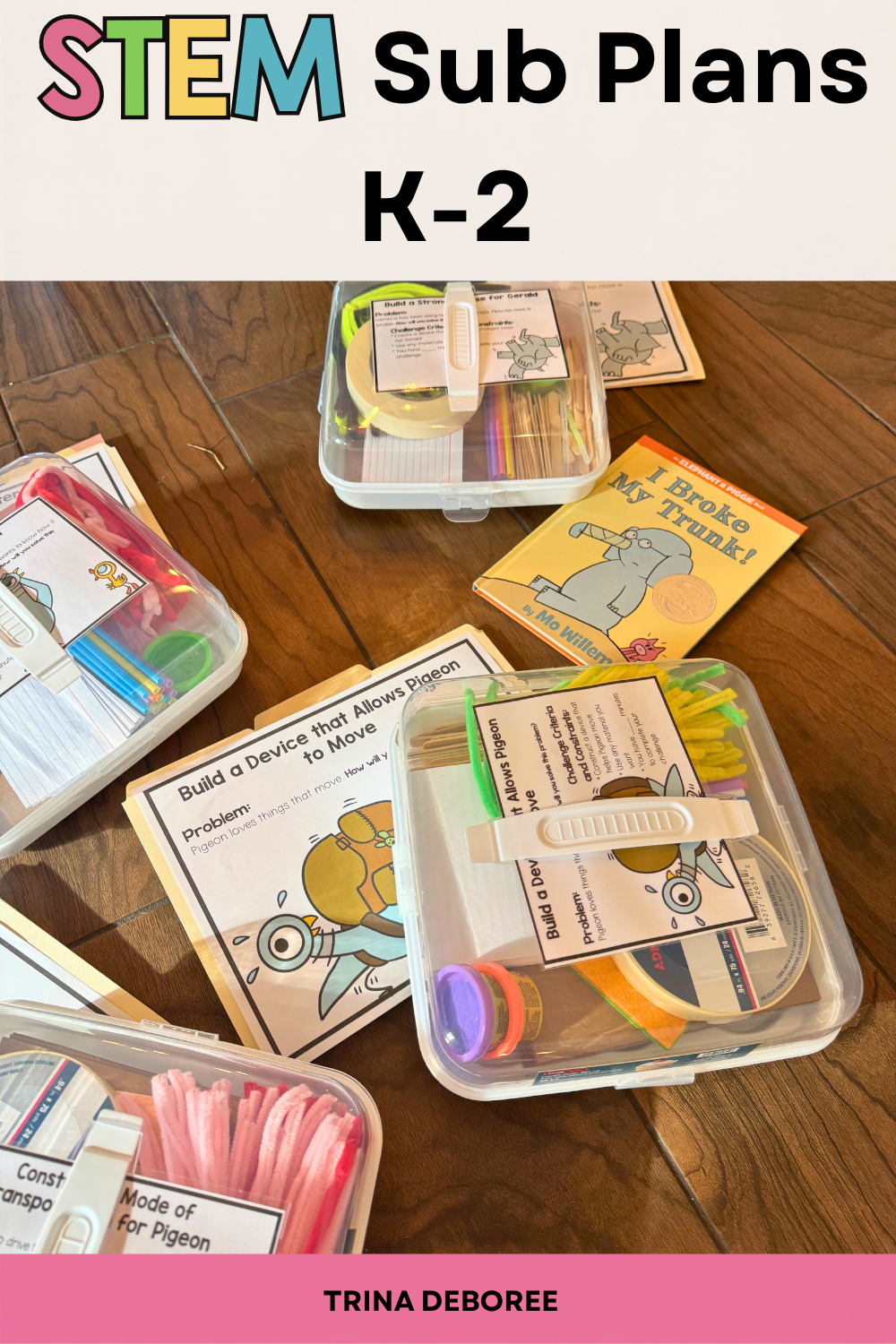
This is where I would make one adjustment.
For younger students, sometimes it helps to give the STEM challenge a little more context.
A picture book can do that beautifully.
Instead of asking kindergarteners to solve an abstract engineering problem, give them a problem connected to characters they already understand.
For K–2, I love storybook STEM for exactly this reason.
My Elephant & Piggie STEM activities include 10 challenges inspired by Elephant & Piggie stories.
Students listen to a read-aloud, identify a problem, and then create a solution.
You're combining:
Read aloud + comprehension + problem solving + engineering + hands-on STEM
For younger students, that story context can make the problem much easier to understand.
It also gives a substitute a natural lesson structure:
Read the book.
Talk about the problem.
Introduce the challenge.
Plan.
Build.
Test.
Reflect.
Done.
For a K–6 STEM teacher trying to simplify emergency plans, I could see using storybook STEM with K–2 and more independent engineering challenges with grades 3–6.
Do My STEM Sub Plans Need to Be Impressive?
I think sometimes we make emergency sub plans harder than they need to be because we're trying to recreate a normal day.
But it isn't a normal day.
You're not there.
The goal isn't to prove how much learning can be packed into one class period.
The goal is to create a day that is manageable for the adult who walks into your classroom and still meaningful for your students.
That might mean one STEM challenge.
A few simple materials.
One planning sheet.
Time to build.
Time to test.
A reflection.
That's enough.
The best special area sub plans aren't necessarily the ones with the most activities.
They're the ones another person can actually pick up and teach.
And when you create that system before you need it, an unexpected absence no longer requires an early-morning scramble to figure out what five or six different grade levels are going to do without you.
Your binder is ready.
Your STEM tub is ready.
Your students know the routine.
And you can take care of whatever pulled you away from school that day.